ByJohn A
How to Automate Pick, Pack, and Ship in Your Warehouse WMS
| Table of Contents 01 What pick, pack, and ship means 02 The pick pack ship process and where automation pays off 03 How order picking works and the types of picking strategies 04 How to automate pick, pack, and ship: the technology stack 05 Order fulfillment module design inside your WMS 06 Wave vs batch picking software and pick-to-light development 07 How to reduce picking errors 08 How much warehouse fulfillment automation costs 09 Case study: automating fulfillment across five sites 10 How to hire developers for a fulfillment system |
As a Technical Project Manager at Acquaint Softtech, a software product development partner, I have watched order fulfillment quietly become the most expensive and error-prone part of a warehouse, because picking alone can eat more than half of daily operating effort.
The fix is to automate the pick pack ship process inside your own WMS, so orders sync, pick paths optimise, packing verifies itself, and carrier labels print without anyone retyping a thing. This guide shows how to automate pick pack ship warehouse operations end to end, from module design to real build cost.
The pressure is real. The US Bureau of Labor Statistics reports the transportation and warehousing sector employed 6.6 million people in June 2024, about 5 percent of all private-sector jobs, and warehouse labour keeps getting harder to hire and keep. Order picking is the single biggest cost centre on the floor, commonly cited at more than half of warehouse operating effort, which is why automating it pays back fastest. Automate warehouse order processing well and you cut errors, speed dispatch, and scale without adding headcount.
This guide is the fulfillment-layer companion to the Complete Guide to Logistics and Supply Chain Software Development, which covers WMS, TMS, OMS, and inventory builds in depth. It draws on real warehouse order fulfillment modules Acquaint Softtech has shipped as an Official Laravel Partner, with 1,300+ projects, 70+ in-house engineers, and clients across the USA, UK, Europe, Australia, and New Zealand who deploy dedicated teams within 48 hours of brief.
What pick, pack, and ship means
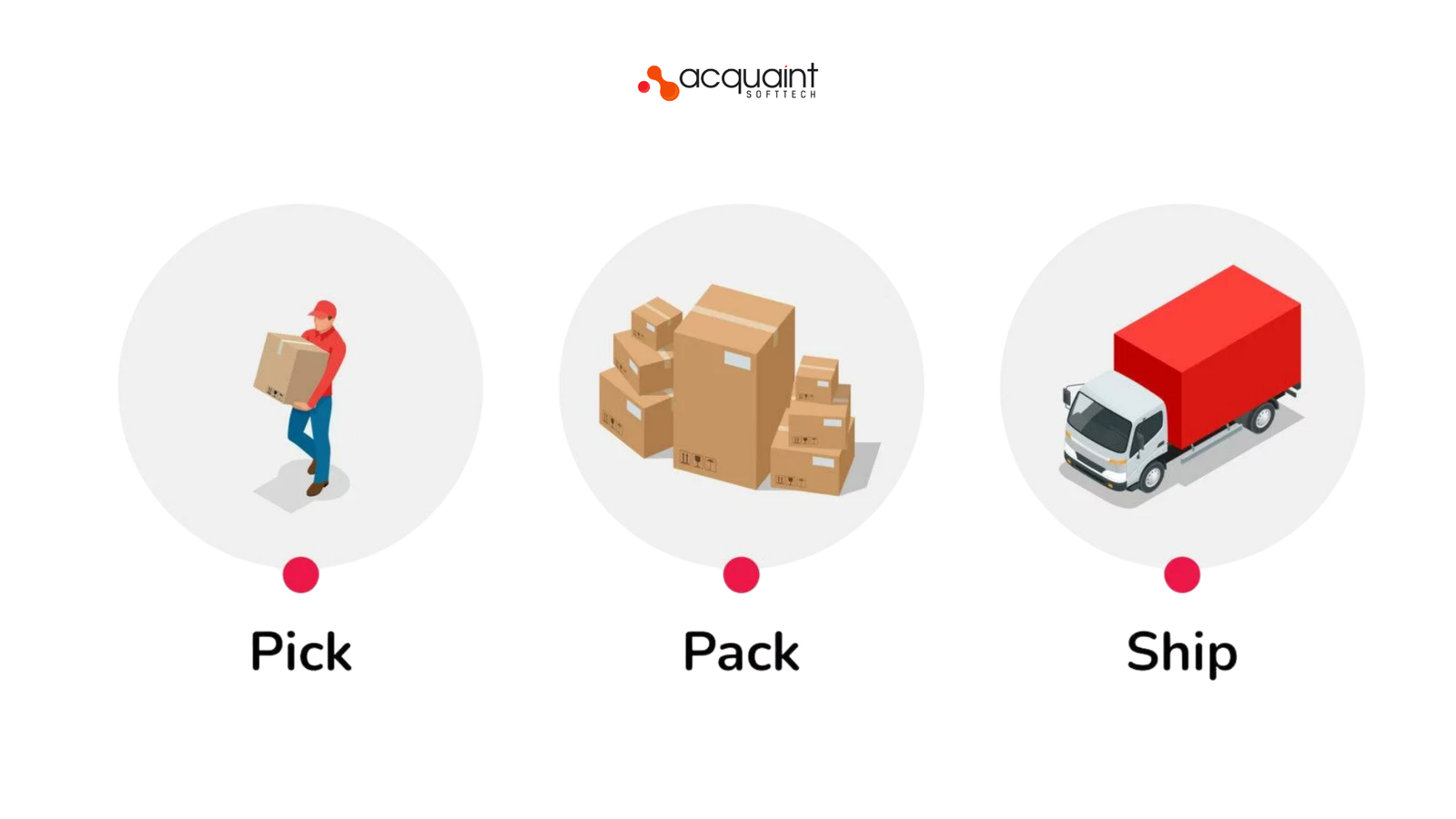
Pick, pack, and ship is the core warehouse order fulfillment workflow that turns a placed order into a verified, protected parcel with an accurate carrier label and tracking. Pick pulls the ordered items from their locations, pack verifies and boxes them, and ship prepares the carrier label and dispatches the parcel. Automating it means software drives each step instead of paper and manual entry.
The three stages are simple to name and hard to run well at volume, which is why most teams start with a scoping exercise before touching code. Picking is the costliest and most error-prone stage, packing is where verification and right-sizing happen, and shipping is where carrier choice and label accuracy decide cost and delivery speed. A discovery workshop maps your real order profile and settles what to automate first, before any budget is committed.
The pick pack ship process and where automation pays off
The automated pick pack ship process runs in four stages: order sync, smart picking, automated packing, and label and dispatch. The WMS imports online orders, checks stock, and groups them into intelligent batches; the system routes pickers or robots; packing verifies items and right-sizes the box; then shipping software picks the carrier, prints the label, and sorts the parcel for the dock. Each stage removes a manual hand-off where errors used to creep in.
| Stage | What automation does | Payoff |
| Order sync | Imports orders, checks stock, batches intelligently | Fewer stockouts and no manual re-keying |
| Smart picking | Optimises routes or commands robots to a workstation | Less travel time, faster picks |
| Automated packing | Verifies items, right-sizes the box, prints slips | Fewer mis-packs, lower dimensional weight |
| Label and dispatch | Chooses carrier, prints label, sorts to dock | Cheapest route, instant tracking |
Automation pays off most where orders enter the system, because most fulfillment errors start with a bad or duplicated order. Syncing directly from your sales channels removes that risk, and when the storefront runs on those platforms, teams hire WooCommerce developers or hire WordPress developers to build the connector.
The order-sync and batching logic itself is commonly built when team hire Laravel developers for the backend.
How order picking works and the types of picking strategies
Order picking works by telling a worker or robot exactly which items to collect, in what order, along the shortest route, then confirming each pick with a scan or light.
The four main types of picking strategies are piece, batch, zone, and wave, and the right one depends on your order volume and SKU overlap. Picking is where automation saves the most, because it is the most labour-intensive stage.
| Strategy | How it works | Best for |
| Piece picking | One order at a time | Low volume, small operations |
| Batch picking | Similar SKUs across many orders at once | High SKU overlap, ecommerce |
| Zone picking | Pickers assigned to fixed areas | Large warehouses, many SKUs |
| Wave picking | Batches within zones, released on a schedule | High volume tied to ship cutoffs |
What is the most efficient way to pick items in a warehouse? For most fast-moving operations it is batch or wave picking, because grouping cuts the travel time that dominates picking cost. The best picking method for small warehouses, by contrast, is usually piece or simple batch picking, since the overhead of zone and wave logic is not worth it at low volume. How order picking works in software is a routing and assignment problem, the same class of optimisation our team applies in real-time platforms covered in the on-demand app development guide, and the dashboards are commonly built when teams hire MERN stack developers.
How to automate pick, pack, and ship: the technology stack
How do I automate my warehouse? You integrate the WMS with four technology layers: assisted picking tools, goods-to-person robotics, automated packing and sorting, and shipping integration.
The WMS is the brain that syncs orders, optimises pick paths, and tracks inventory in real time; the other layers execute what it decides. You do not need all of them at once, you phase them onto the workflows that hurt most.
| Layer | Technology | Role |
| Assisted picking | RF scanners, pick-to-light, voice headsets | Guide workers to the right item fast |
| Goods-to-person | AMRs, AS/RS robotics | Bring inventory to a stationary operator |
| Packing and sorting | Box-sizers, weight checks, conveyors | Verify, right-size, and sort automatically |
| Shipping | Carrier label and tracking integration | Auto-select carrier, print, and dispatch |
Off-the-shelf goods-to-person robotics like the Pio warehouse system bring items to a stationary operator, which suits smaller sites that cannot rebuild their racking. Before buying any hardware, model throughput with a pack and ship warehouse simulator so you size the automation to real demand, not a guess.
The intelligent routing and demand-prediction layer on top of the WMS is built with Acquaint Softtech’s AI development services; teams hire AI/ML engineers for that model work, while robotics and conveyor integration is handled when they hire automation engineers.
Order fulfillment module design inside your WMS
Good order fulfillment module design keeps the fulfillment logic as clean, well-bounded modules inside your WMS: an order service, a picking service, a packing service, and a shipping service, connected by events. Each owns its own state and exposes an API, so you can automate one stage without breaking the others. This is what lets you automate pick pack ship warehouse tracking so every order’s status is live from sync to dispatch.
The data flow is event-driven. An order event triggers a pick task, a confirmed pick triggers a pack task, a verified pack triggers a label, and each transition writes an audit trail. Building this to stay reliable under peak load is where a dedicated development team earns its place, and the services themselves are commonly built when teams hire Python developers or hire Django developers for the rules and API layer.
Wave vs batch picking software and pick-to-light development
Wave vs batch picking software comes down to timing: batch picking groups orders by shared SKUs and releases them together, while wave picking releases those batches on a schedule tied to carrier cutoffs and labour. Batch maximises picker efficiency; wave adds control over when work hits the floor. Most high-volume warehouses run wave picking on top of batching, and good software lets you switch strategy per shift.
Pick-to-light system development connects the WMS to light modules on each shelf bay, so a picker follows lit prompts instead of reading a screen, which cuts errors and training time. The integration is a hardware-plus-software job: the WMS sends pick instructions to a controller, and confirmed picks flow back as events.
The controller and network integration is set up when teams hire DevOps engineers, and teams that need to add this capability fast use IT staff augmentation. The same field-service style dispatch logic appears in our guide on developing field services management software.
How to reduce picking errors
You reduce picking errors by removing human judgement from the loop: scan-verify every pick, guide pickers with lights or voice, and block the next step until the current one is confirmed. Barcode or RFID verification at pick and again at pack catches wrong-item and wrong-quantity errors before they ship. Automation does not just speed picking, it makes each pick provable.
The highest-impact fixes are scan-to-confirm at every hand-off, right-sizing at pack to avoid the wrong box, and a clear exception path for missing or damaged stock. A reliable scanner app for pickers is often built when teams hire React Native developers, and keeping accuracy high after launch depends on ongoing support and maintenance as SKUs and layouts change.
Read Also: Building an Open Banking Aggregator: Connecting Banks, Fintechs, and Users
How much warehouse fulfillment automation costs
A pick, pack, and ship automation module typically costs $30,000 to $60,000 for a focused build, $70,000 to $130,000 for a full fulfillment module with carrier integrations, and more once robotics hardware is added on top of the software.
Software cost is driven by the number of workflows, integrations, and sites. The automate pick pack ship warehouse cost is almost always recovered in reduced labour and fewer mis-ships.
| Build scope | Typical software cost | Timeline |
| Focused pick-pack-ship module | $30,000 to $60,000 | 2 to 4 months |
| Full fulfillment module | $70,000 to $130,000 | 4 to 7 months |
| Module plus robotics integration | $130,000+ | 6 to 10 months |
How much does it cost to automate a warehouse overall? Software is the smaller line item; the bigger variable is hardware, from a few scanners to full goods-to-person robotics.
Building the software with a Clutch-verified India-based team keeps custom pick pack ship software at $25 to $49 per hour, up to 40 percent below Western agency rates. Teams that want a full managed build hire remote developers, while those who need only delivery leadership add a virtual CTO, and reporting dashboards are built when teams hire MEAN stack developers.
How to hire developers for a fulfillment system
To hire developers for a fulfillment system, look for teams that have shipped event-driven, real-time warehouse modules and carrier integrations, not just basic CRUD apps. The specialist skills are order-event orchestration, scanner and device integration, and carrier-label APIs. Most companies either outsource the whole build or augment a small core team with these specialists.
| Model | Best for | What you get |
| Outsourcing | No in-house engineering | A full managed fulfillment build |
| Staff augmentation | A lean tech team | Fulfillment and integration specialists |
| Hybrid | Scaling operations | In-house control plus a vendor bench |
Outsourcing suits teams with no in-house engineering who want a whole build managed end to end, available through software development outsourcing. Teams with a technical lead can hire project managers and engineers on demand, with vetted people deployed within 48 hours, and can modernise a legacy WMS first through a version upgrade.
Whichever model you choose, keep control of scope and accuracy targets rather than handing everything over. Agencies that resell a fulfillment product under their own brand often build it through white label development. Team stability matters more than a low hourly rate, which is why Acquaint Softtech keeps the same core team on a platform from first release through scale.
Frequently asked questions
What is pick pack and ship?
Pick, pack, and ship is the core warehouse order fulfillment workflow that turns a placed order into a verified, protected parcel with an accurate carrier label and tracking. Pick pulls the items, pack verifies and boxes them, and ship prepares the carrier label and dispatches. Automating it means software drives each step instead of paper and manual entry.
How do I automate my warehouse?
Automate a warehouse by connecting your WMS to assisted picking tools, goods-to-person robotics, automated packing and sorting, and shipping integration. The WMS syncs orders, optimises pick paths, and tracks stock in real time, while the other layers execute. Phase it onto the workflows that hurt most, starting with picking, rather than all at once.
How to automate order fulfillment?
Automate order fulfillment by syncing orders into the WMS, batching them intelligently, routing pickers or robots, verifying items at pack, and auto-generating carrier labels. Build it as clean modules, an order service, picking service, packing service, and shipping service, connected by events so you can automate one stage at a time without a rebuild.
How to pick and pack in a warehouse?
Pick by following an optimised route and scanning each item to confirm it, then pack by verifying the items against the order, right-sizing the box, adding protective fill, and printing the packing slip. Scan-verify at both pick and pack so wrong-item and wrong-quantity errors are caught before the parcel ships.
What is the most efficient way to pick items in a warehouse?
For most fast-moving operations, batch or wave picking is the most efficient, because grouping orders by shared SKUs cuts the travel time that dominates picking cost. Small, low-volume warehouses are usually better with piece or simple batch picking, since zone and wave logic add overhead that is not worth it at low volume.
Best picking method for small warehouses?
The best picking method for a small warehouse is usually piece picking or simple batch picking. It keeps the process easy to run and train, and the travel-time savings from zone or wave picking only justify their complexity once order volume and SKU count grow. Start simple and add strategy as you scale.
How to reduce picking errors?
Reduce picking errors by scan-verifying every pick, guiding pickers with pick-to-light or voice, and blocking the next step until the current one is confirmed. Add a second verification at pack and a clear exception path for missing or damaged stock. Automation makes each pick provable, not just faster.
How much does it cost to automate a warehouse?
A pick, pack, and ship automation module typically costs $30,000 to $60,000 for a focused build and $70,000 to $130,000 for a full module with carrier integrations, plus hardware. With a Clutch-verified India team at $25 to $49 per hour, custom pick pack ship software lands up to 40 percent below Western agency rates.